

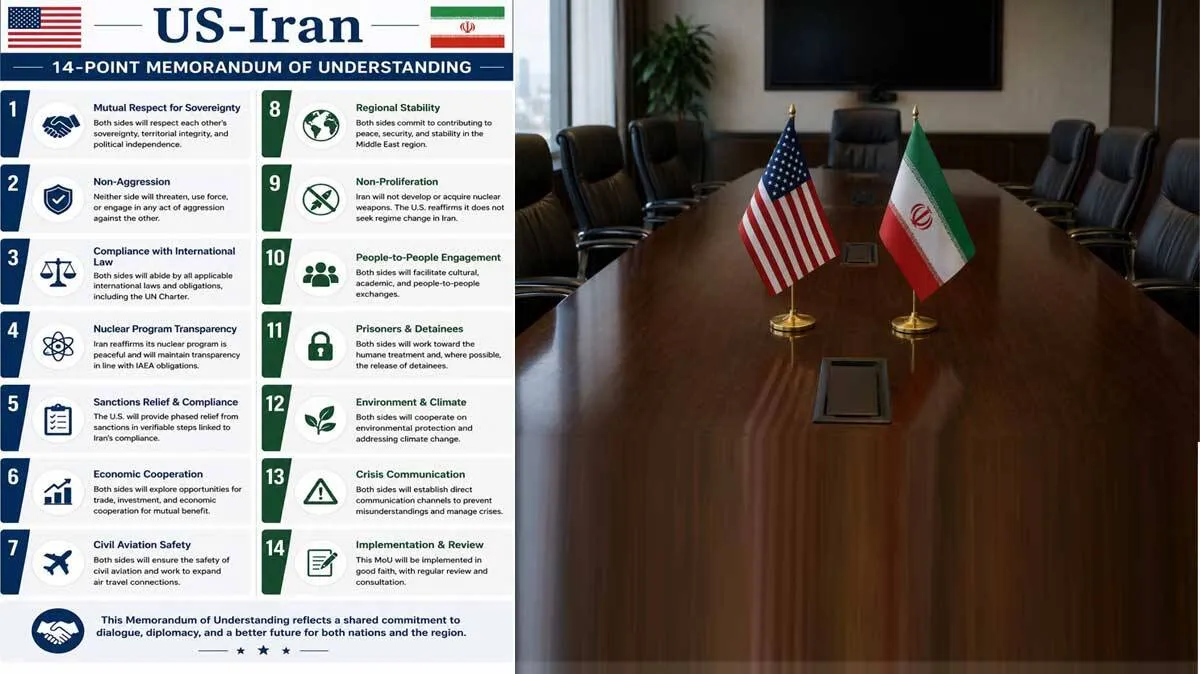
The ink is barely dry on the US-Iran Memorandum of Understanding, yet its significance is already clear: this is a tactical pause, not a transformative peace. After months of escalation that disrupted global energy flows, Washington and Tehran have agreed to an immediate halt to hostilities, the reopening of the Strait of Hormuz, and a 60-day window for technical talks on Iran’s nuclear programme. The 14-point framework includes sanctions waivers for Iranian oil exports, discussions on frozen assets, and a reported funding envelope for reconstruction - all without full structural resolution of underlying tensions.
For India, the real story lies not in the details of the deal itself but in what it reveals about the effectiveness of our independent, interest-driven foreign policy. In a region where great powers often demand alignment, New Delhi’s calibrated multi-alignment has once again demonstrated its value.
A US exit strategy
The MOU allows Washington an off-ramp from a conflict that had become strategically costly and economically disruptive. What began as pressure on Iran’s nuclear and regional activities risked prolonged entanglement, higher global oil prices, and domestic political complications. The agreement delivers a measurable win: resumed maritime traffic through Hormuz, immediate sanctions relief for Iranian oil, and a structured window to address enrichment limits and stockpiles. Both sides retain the right to walk away, preserving US leverage.
This is transactional statecraft at its clearest - de-escalation without structural capitulation. It frees American bandwidth for higher-priority theatres while mitigating the risk of a broader energy shock.
Breathing room for Iran, with limits
For Tehran, the deal provides essential economic oxygen. The lifting of the naval blockade and the prospect of oil sales offer immediate relief after infrastructure damage and isolation. It also buys time to stabilize internal pressures and reposition regional assets. Yet the risks remain sharp: disputes over IAEA access, verification mechanisms, or proxy activities in Lebanon could quickly unravel the truce. Iran has secured a pause, not a pardon.
India’s quiet effectiveness
India’s handling of the crisis stands out for its pragmatism. While others were drawn into escalation cycles, New Delhi maintained open channels with Washington, Tehran, and Gulf partners alike. Backchannel coordination helped facilitate evacuations and ensured continuity in energy trade within sanctions limits. The result? A reopened Strait of Hormuz that directly benefits our import-dependent economy and protects remittance flows - outcomes especially relevant for states like Kerala deeply integrated with Gulf markets.
This approach avoided the trap of performative visibility or ideological posturing. In a conflict shaped by great-power coercion, influence often lies in preserving optionality rather than claiming a seat at every table. Critics may argue India did not “shape outcomes,” but that misses the point: by refusing to lock into any single bloc’s narrative, New Delhi protected core interests - energy security, safe sea lanes, and connectivity projects such as Chabahar - while keeping future flexibility intact.
The MOU vindicates this method. Stable energy prices create fiscal space for the Centre and states alike, easing subsidy burdens and supporting capital expenditure. It also provides a more predictable environment for executing existing trade agreements and advancing new ones - areas where domestic reforms in logistics, skills, and standards remain critical.
The road ahead: Focus on execution
The real test begins now. The next 60 days will determine whether inspection disputes or proxy flare-ups derail progress. For India, three priorities stand out. First, accelerate energy diversification - including strategic reserves with private participation and rupee-based trade mechanisms - to reduce future vulnerability. Second, push implementation of FTAs and supply-chain resilience under “China plus one.” Third, strengthen federal coordination so that national gains from regional stability translate into tangible state-level outcomes.
Frameworks matter, but execution determines results. The US-Iran pause gives the region an opportunity. India is well positioned to benefit - provided we treat this respite as a call for deeper preparedness rather than complacency.
In foreign policy, as in economics, prudence and persistence remain our strongest assets.









 HOME
HOME LATEST
 NOTIFIED NEWS
 POLL
POLL KERALA
  EDITORIAL
  INDIA
INDIA  WORLD
WORLD  CINEMA
  SPORTS
  LIFESTYLE
  SPECIAL
  SCIENCE & TECHNOLOGY
 |
|