

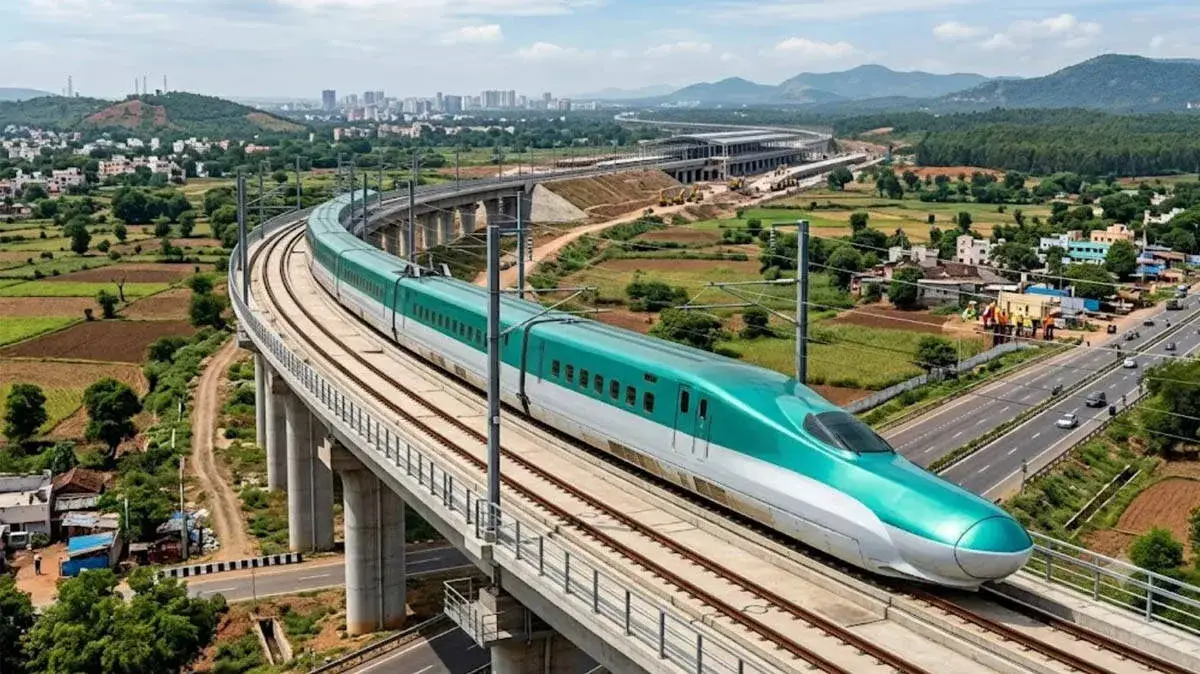
NEW DELHI: Union Railway Minister Ashwini Vaishnaw informed that India’s bullet train trial runs will be between May and June 2027. He said the inauguration would take place after the trial period of two to four months. He made the announcement while speaking at the ‘Namo for Viksit Bharat’ programme held in Vadodara. The union minister also said that the first body frame of the bullet train had recently been completed and sent for squeeze testing.
‘India’s indigenous bullet train will arrive on the tracks for trial runs by May or June next year. After a trial period of two to four months, the Prime Minister himself will inaugurate the service. The bullet train project is being developed in line with the vision of Atmanirbhar Bharat (self-reliant India). Travelling by bullet train from Vadodara will allow passengers to reach Mumbai in just one and a half hours. Work on the project is progressing rapidly. Construction of the Surat–Vapi section will be completed by December this year,’ he said.
Major changes in Indian railways
The minister also highlighted the changes introduced in Indian Railways in recent years. He said the railway system is undergoing extensive modernisation, with changes being made to operating systems, ticket reservation platforms and construction methods.
The government also plans to manufacture new wagons for specialised freight transportation, including wagons specifically designed to transport salt. The minister also pointed to the completion of several long-pending railway projects, including the Chenab Bridge and the railway link connecting Mizoram to the national rail network.
Bullet Train Corridor
Ashwini Vaishnaw also pointed about the proposed high-speed rail corridor between Delhi and Lucknow. The 495-kilometre journey is expected to take just 2 hours and 12 minutes under the proposed project.
The proposed high-speed connection is expected to significantly reduce travel time between the two cities. The distance between Delhi and Kanpur on the proposed corridor is estimated to be around 455 kilometres.












 HOME
HOME LATEST
 NOTIFIED NEWS
 POLL
POLL KERALA
  EDITORIAL
  INDIA
INDIA  WORLD
WORLD  BUSINESS
  CINEMA
  SPORTS
  LIFESTYLE
  SPECIAL
  SCIENCE & TECHNOLOGY
 |
|