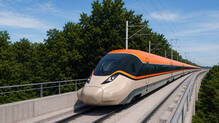


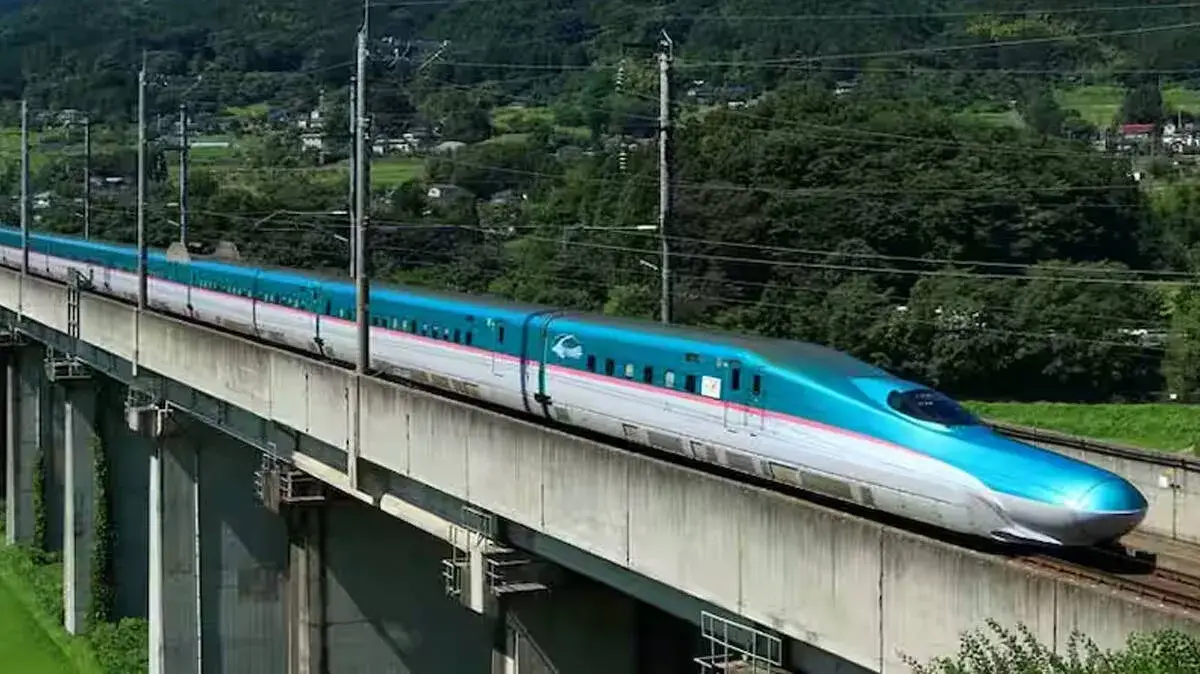
NEW DELHI: The construction of India’s first bullet train project, designed to operate at speeds of up to 320 kmph, is progressing fast. Several advanced technologies are being used in the Mumbai-Ahmedabad High-Speed Rail Corridor. One of the key technologies is the ‘canted turnout’, a special system designed to ensure that passengers do not experience sudden jerks or impacts when a high-speed train changes from one track to another.
The 508-kilometre-long Mumbai-Ahmedabad bullet train corridor is being constructed by the National High Speed Rail Corporation Limited (NHSRCL). For a train capable of reaching speeds of up to 320 kmph, changing tracks at high speed is a major challenge. The canted turnout technology is being used as a solution to this challenge.
What happens when a train changes tracks?
The section of a conventional railway track that allows a train to shift from one track to another is not constructed with a uniform gradient. When a train passes through such a turnout, its wheels encounter a sudden change in the track geometry. As the train’s speed increases, this can generate greater forces and cause vibrations and discomfort for passengers.
Therefore, conventional trains generally need to significantly reduce their speed while changing tracks. However, this method is not suitable for high-speed trains such as bullet trains.
What is a ‘canted turnout’?
A canted turnout is a system that maintains the required inclination, or cant, of the track even at the section where the train changes tracks. Under this system, the outer rail is positioned higher than the inner rail on curves.
This inclination helps control the forces generated when a train travels through a curve. Maintaining the required cant while changing tracks helps reduce sudden forces acting on the train and its wheels and ensures a smoother track transition.
As a result, even when travelling at hundreds of kilometres per hour, passengers can experience a smoother and more comfortable track change.
When will bullet train begin service?
The bullet train project is presently undergoing various tests, including the ‘squeeze test’. According to the latest information on the project, construction of the first section is targeted for completion by December 2026.
The government aims to commence the first service on the approximately 100-kilometre Surat–Vapi section on August 15, 2027. The train is expected to cover this distance in around 20 minutes.
The entire 508-kilometre corridor from Bandra-Kurla Complex in Mumbai to Sabarmati in Ahmedabad is targeted for completion by December 2029. The project was officially launched on September 14, 2017.











 HOME
HOME LATEST
 NOTIFIED NEWS
 POLL
POLL KERALA
  EDITORIAL
  INDIA
INDIA  WORLD
WORLD  CINEMA
  SPORTS
  LIFESTYLE
  SPECIAL
  SCIENCE & TECHNOLOGY
 |
|