

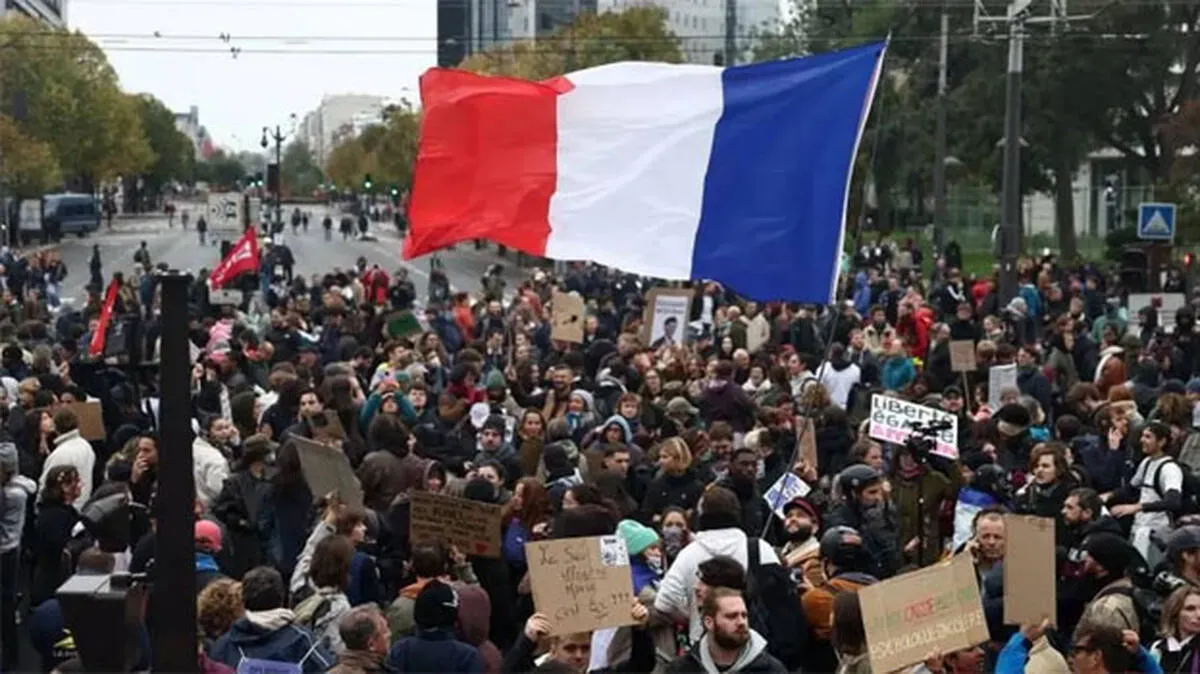
PARIS: France stepped up security on Saturday as protests over rising living costs, education funding and public services continued across the country. Authorities mobilised 70,000 police officers and gendarmes to prevent a repeat of the violence, looting and vandalism that marked demonstrations the previous weekend.
Interior Minister Laurent Nuñez said 135 people had been arrested nationwide by early afternoon on Saturday. Police also seized items that could be used as weapons during preventive searches. Water cannons, helicopters and armoured vehicles were among the resources deployed or made available to security forces.
Around 3,000 shops across France were damaged or looted during the previous weekend's unrest, according to reports. The authorities tightened security around commercial areas and major public institutions amid fears of further violence.
Several major cultural attractions in Paris were closed on Saturday as a precaution. The Louvre and the Musée d’Orsay were among the institutions that shut their doors. The Picasso Museum and the Grand Palais were also closed, while more than 20 metro stations in the capital were shut.
Police imposed last-minute restrictions on the main demonstration planned in Paris, changing the route from the proposed Bastille-to-Nation march to a route between Porte d’Italie and Porte de Vincennes, on the southeastern edge of the capital. The decision drew criticism from some protest organisers and political figures, who accused the authorities of obstructing demonstrations.
The protests, which began last month with students raising concerns about staff shortages and conditions at schools, have expanded into a broader movement involving students, workers and trade unions. Demonstrators are demanding 250,000 additional places in higher education and an end to the selection system used for university admissions. Their demands also include an additional monthly student grant of 200 euros, more teachers, repairs to schools and universities, and a freeze on rents in public student housing. Higher wages and pensions are among the wider demands raised during the protests.
Meanwhile, separate demonstrations over economic and political grievances have also taken place in other European countries. In Italy, protests have focused on living costs, wages, employment, public services and access to housing, with some demonstrations turning violent. In Spain and Portugal, housing affordability and rising living costs have been major concerns. In Albania, students and other protesters have demonstrated over education conditions, tuition costs and alleged government corruption, with some calling for Prime Minister Edi Rama to resign.
Although the demonstrations share concerns about economic insecurity and public services, reports indicate that they are separate movements rather than a single coordinated protest campaign.











 HOME
 LATEST
 NOTIFIED NEWS
 POLL
 KERALA
 EDITORIAL
 INDIA
 WORLD
 BUSINESS
 CINEMA
 SPORTS
 LIFESTYLE
 SPECIAL
 SCIENCE & TECHNOLOGY

 |