


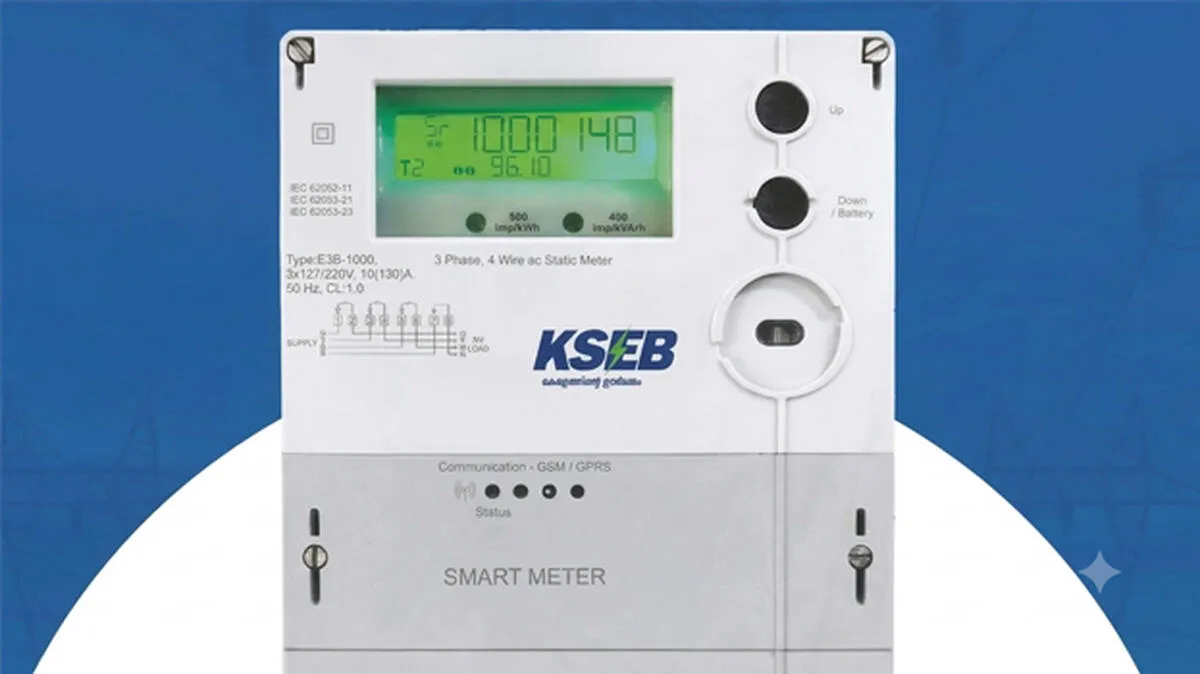
THIRUVANANTHAPURAM: The Kerala State Electricity Board (KSEB) is likely to award the contract for transitioning its consumers to smart meters to Adani Energy Solutions. When the state power utility invited tenders in May, 11 companies, including Adani, participated in the bidding process. The tenders are scheduled to be opened later this month, and sources indicate that Adani has submitted the most competitive and favourable proposal.
Kerala currently has a total of 1.40 crore electricity consumers. In the first phase of the project, KSEB transitioned 1.72 lakh consumers to smart meters, covering government offices, public sector undertakings, and High Tension (HT) categories. The upcoming second phase will see 50 lakh consumers shifted to the smart meter system, prioritising solar energy prosumers, consumers with a monthly usage exceeding 150 units, and new connections. The contract for this massive second-phase rollout is the one expected to be awarded to Adani.
The initial phase of installing 1.72 lakh smart meters was executed by Kolkata-based Iskrameco, funded through a ₹65 crore loan availed by KSEB. However, that project hit a roadblock after the company’s software malfunctioned, forcing KSEB to revert to manual meter readings and conventional billing. Furthermore, while the Central Government had initially promised to provide 15 percent of the project cost as financial assistance during the first phase, that promise was ultimately not fulfilled.
Adani’s new proposal offers significant financial relief to the debt-ridden power board, as the company has offered to bear the entire implementation and operational cost, ensuring KSEB does not incur any additional loan liabilities. Under the proposed terms, Adani will manage the supply, implementation, and maintenance of the smart meters, and will eventually transfer the entire system, including the software, to KSEB.
However, the transition will entail a higher cost for consumers. A prepaid smart meter costs approximately ₹4,000, compared to the ₹800 price tag of the conventional meters currently in use. Consequently, the monthly meter rent for single-phase consumers will rise from the current ₹6 to ₹31, increasing their bimonthly bill charge from ₹12 to ₹62. For three-phase consumers, the monthly rent will be ₹36, translating to a bimonthly charge of ₹72. Low Tension Current Transformer (LT-CT) consumers will face a monthly meter rent of ₹47.
Despite the higher rental charges, the smart meter system is expected to offer several long-term benefits to consumers and the utility provider. Operating on a prepaid basis, the smart meters allow users to recharge in advance, enabling them to monitor and regulate their own power consumption. Additionally, consumers will only have to pay for the exact amount of electricity they use, eliminating electricity bills for unoccupied houses, while helping KSEB effectively curb power theft across the state.













 HOME
HOME LATEST
 NOTIFIED NEWS
 POLL
POLL KERALA
  EDITORIAL
  INDIA
INDIA  WORLD
WORLD  BUSINESS
  CINEMA
  SPORTS
  LIFESTYLE
  SPECIAL
  SCIENCE & TECHNOLOGY
 |
|